


Radon Testing in Kelowna & the Okanagan
Health Canada recommends every home be tested for radon. Here's how testing works for Kelowna and Okanagan homes, and which option fits your situation.
Choose the right test
Duration and method depend on why you're testing.


Two valid methods, different jobs
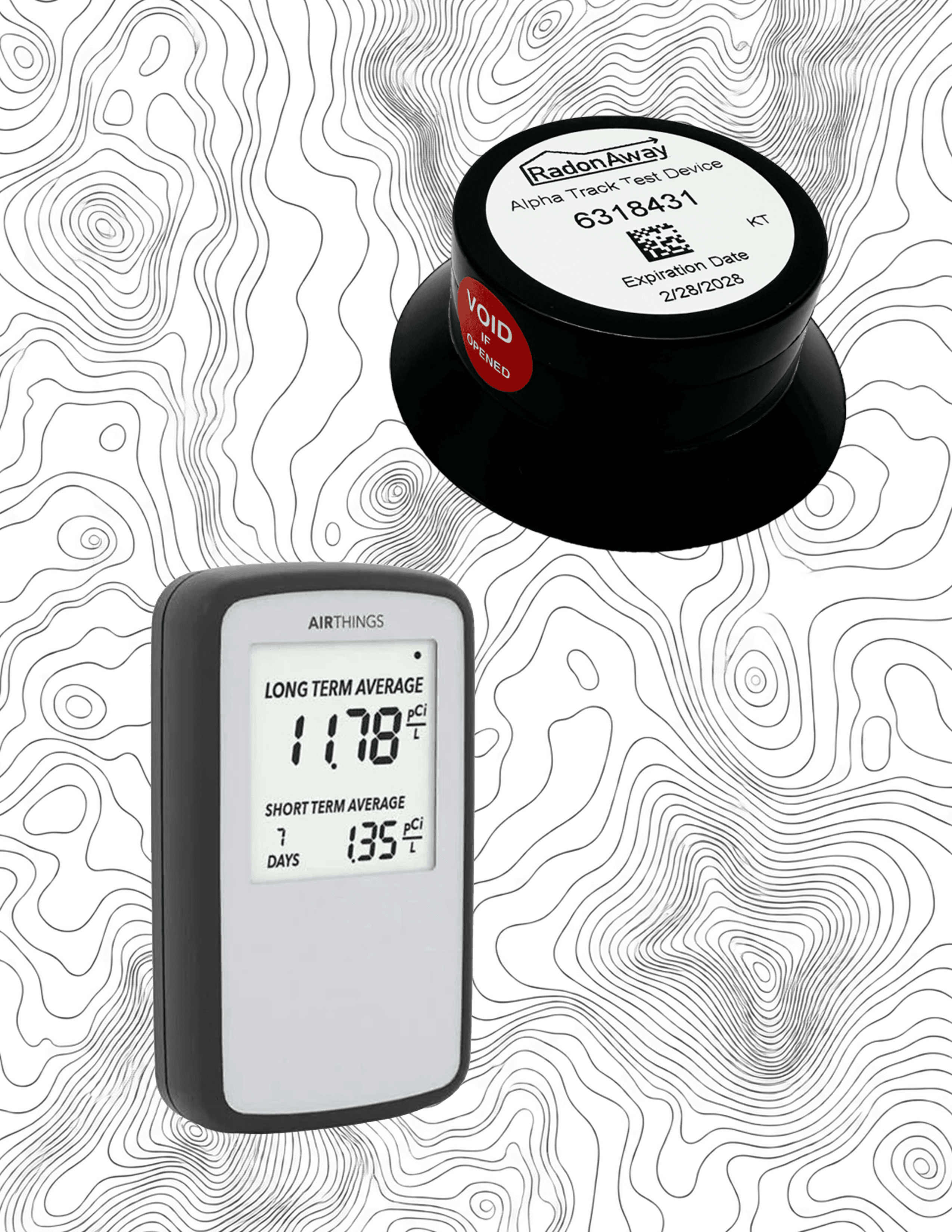
Long-term testing (90+ days, Alpha-track detector) — Health Canada's preferred method. Because it runs across weeks or months, it captures the seasonal swings radon levels naturally go through — a short snapshot can't.
Short-term testing (2–7 days, Continuous radon monitor) — A reasonable screening tool for real estate timelines, though it provides a less complete picture than a long-term test.
Closed-house testing conditions
- Windows and doors stay closed for 12 hours before and during testing, aside from normal entry and exit.
- Fans that alter air pressure (e.g. exhaust fans run for extended periods) are avoided during the test.
- Normal heating and cooling operation continues throughout.

Interpreting your radon result
Below 200 Bq/m³
No action required
200–600 Bq/m³
Reduce within two years
Above 600 Bq/m³
Reduce within one year
A result at or above 200 Bq/m³ is a confirmed measurement, not an emergency — request a mitigation assessment when you’re ready, or read what a high result means in more detail. Below the guideline, periodic retesting — or an ongoing monitoring plan — confirms it stays that way.
Frequently Asked Questions
A long-term test — Health Canada's preferred method — runs 90+ days using an alpha-track detector, capturing seasonal variation a shorter test can't. A short-term test runs 2–7 days with a continuous monitor, useful when a real estate closing date won't wait.
In the lowest livable level of the home — the space people actually spend time in — away from kitchens, bathrooms, and laundry rooms where humidity and ventilation can skew a reading.
Health Canada's guideline sets 200 Bq/m³ as the action level. Between 200 and 600 Bq/m³, it recommends mitigation within two years; above 600 Bq/m³, within one year. Below 200 Bq/m³, no action is required, though periodic retesting is still worthwhile.
Consumer test kits exist, but placement, duration, and closed-house conditions all affect accuracy. We handle those details as part of a professional test, and a real estate transaction typically needs documentation a self-administered kit doesn't provide.
Any time closed-house conditions can be maintained, though heating-season testing (fall through spring) captures the conditions Okanagan homes are in for much of the year. A 90+ day long-term test run through winter naturally includes that higher-radon window.
Below 200 Bq/m³, no action is required, though periodic retesting is worthwhile. At or above 200 Bq/m³, the next step is a mitigation assessment — not an emergency reaction, since Health Canada's guideline gives one to two years to act depending on the level.
Ready to test?
Book a long-term home test, a short-term real estate test, or a commercial multi-point assessment.
Not sure which test you need? →Already Have a Radon Result? →